Sunday, September 14, 2014

friendly futures

March 19th, 2049
By-and-By the Rising Tide
Upland, Penn's Woodland, The New World

My General, My Leader, My Liege,

Today has been more remarkable than most in the old Hansen house-hold!  The sovereign lady of the estate awoke with a fiery thirst for cider, which no mortal reason could o'erpow'r.  Deaf to my protests, she forbade its absence with a truly regal wave of her hand, and off I went to the store, lickety-split!  I, who once thought myself something of a Lothario, am now reduced to nothing more than a LABRADOR.  I wish I could report that the tragic injustice went fully answered, but yours truly returned in due course from the market with one fine jug of the stuff in each hand (for good measure).  The piquant thirst of the lady satisfied, I was at last able to begin my day in earnest, and would have gotten a fair heft of work out of the way if it weren't for her infernal glug-glugging!  I confess to you, my earnest and discreet friend, that little of the fabric of marriage gets woven on the classical weft of love and kisses.  The greater part of it is, I've learned, hand-sewn from irritants, bad habits, and a bit of cartilage.

The old bag appeased, I set my sights hungrily on my favorite of breakfasts, the story enclosed in your latest epistle.  As expected from your seasoned pen, "The Crime of Eliot Doveman" is quite pleasing, quite pleasing indeed!  I devoured it all in one gulp, and the lady found me smacking my lips happily shortly thereafter.  Your sense for the mysterious and suspenseful is as masterful as ever; to boot, your handling of swordfights and similarly wild scenes has grown tremendously.  As I read, I caught myself ducking to avoid the blows of your "bedeviling ruffians"!  Yes, a bit of the schoolyard bravo came back to me; I rose from my chair to engage the world, and nearly knocked out the floor-lamp!  But do not confuse me with old Don Quijote!  This old man is not about to give up the fight!

I received a note the other day from our Boy Down South, inviting me to take a week or so to visit down there and take in the sights.  I normally wouldn't brave the heat, as you know, but I have yet to see the new layout since the Great Rearrangement, and there's a piece of adventure to it, as well.  The wife has put her imprimatur; all that's left is for you to jump in as well, O Caius!  There's room enough for three, or four, or five!

Lastly, hmph -- thou knowest well how this blustering sage lives, and it's without focusing overmuch on hisself.  I proceed along much ever as I have.  My eyes open, and it's all downhill from there.  But the dreams I have, such dreams!  Take note for when I've gone, my friendly -- Freud himself could not interpret my visions, nor any other somnial sage.  Avast!  You and I each carry secrets, if the world only knew!  I've half a mind that mine are premonitions, but the future's in code, and I'm no cipher.  Lucky Nostradamus, who never knew he did not know!

Welp, the Summer Moon rises, the Winter Sun sets, and the Harvest Boots are out to dry on the patio. I'm off for that conference we'd discussed, the one with too many baguettes and not enough bagels.  Woe to me, that I should think of two instances of travel in the same letter!  Much trust and love to you for your generous offer to oversee our little rodents -- if they give you any trouble, the little "Barbecule" and I are only a tin-can phone-call away.  Now shove off, you rappscallion!  You're scarin' the fishes!!!

With deepest respect & unending servitiude, YRS,
Bartholomew Logjam II

Saturday, September 13, 2014

inner self

Today, I beat Antichamber.


Antichamber is a brilliant, extraordinary game; one that challenges all of your intuitions about three-dimensional space through a series of increasingly abstruse puzzles.  It's the hardest first-person puzzle game I've ever played, and I've played Dr. Brain:  Action Reaction.

Actually, that image above doesn't do this game justice.  Try this.


So you see?  There's a fourth dimension at work here, and I don't mean time.  The spatial relationships between objects that we take for granted are completely disregarded, and you have to create an entirely new system of understanding "place".

The game is also littered with cute little pictures that reveal sage words when you approach them, like this:

Duck?  Or rabbit?

Some of these are profound, some are silly, and some are just confusing.  But all of them comment or hint at the solution to a nearby puzzle, giving you some insight into what you are temporally proximate to solving.

The stark aesthetic of the game does wonders for the mind.  Without the distractions of a visually busy world, your brain is free to focus all of its energy on solving whatever problem is at hand.  In fact, the "exhibit" area, above, has more visual variety than any other spot in the game.  Most of it is just sheets of single unbroken colors, bordered by the occasional think black line.

I've always been interested in map projections.  Once you start learning about the mathematics that go into presenting a three-dimensional surface in two dimensions, you question a lot about something that may have seemed obvious to you before.  One of my favorite professors in law school had a phrase he liked to use whenever we came to an unresolved controversy:  "reasonable minds can differ."  The same goes for the higher questions of almost every field; you reach a point where wrongness ceases to be a factor in discussion, where every answer is equally wrong.  The reason there are so many map projections is because some are good for representing certain features, and some are good for others.  When you reduce the dimensions of something, you can't show it perfectly. Compromises have to be made.  People argue about which parts of the thing are best to lose, but everybody's losing something.

The next time you get into an argument with someone, stop and reflect on this fact.  Is the other person wrong, or just seeing things from a different perspective?  More importantly:  if you can't bring yourself to see from their perspective, it just may be that they have a better vantage point than you.

Friday, September 12, 2014

meat is meet

Today I learned that there is such a thing as cowboy poetry.  While it's far from what I aspire to, we should all appreciate the contributions cowboy poets have made to the American literary landscape.


Be careful following the trail of Baxter Black -- that man could talk you into an ouroboros.  His piece about bovine uterine prolapse is particularly entrancing (the words "whopping big burrito" feature prominently).

Now, as to the above, I've never been much for vegetarianism.  The word alone is enough to get my hackles up.  There are many seemingly good reasons a person might choose not to eat meat -- not wanting to participate in industrialized or spiritual suffering, fearful about health concerns, desiring to feel superior to others -- but these are all fatally flawed.

To exist is to perpetuate and prolong the suffering of others.  We are just misery distributors, at the bottom of it all.  Beyond that, there is zero metaphysical value to "causing suffering."  It is a non-factor.  Stab a man, stab yourself, or just give everybody hugs.  The end is the same.  Your purchase of a piece of cow doesn't change that.

My little rant aside, there's a deeper point to make.  Where does the value of a life come from?  If a cow lives its whole life in a pen before being slaughtered, would it have been better off it it'd never been born?  Does the pain it feels negate any of the joys it might have felt at eating, or even the simple pleasure of being alive?

More importantly, if there's value in those little joys, then there must be less value if there are less fewer.  And if people don't buy meat, then fewer cows will be bred -- less joy overall.  The only consistent viewpoint, as far as pain is concerned, is to think of animals as metaphysical pain machines -- capable of nothing but feeding humans meat and guilt.

As to the health aspects of eating meat, we must recognize that the body is agnostic when it comes to the source of the food going in.  Digestion is a series of chemical processes, and all that matters, really, is quantities.  If you're bad at limiting your intake of certain foods, fine, but it's a mistake to act as if certain foods are straight-up bad for you.  Everything's bad for you in certain quantities, and some things take less of those quantities than others before they start affecting your health adversely.  But you gotta get protein somewhere, and never eating meat is a somewhat draconian approach to monitoring your diet.

I can't argue with the aspect of superiority, though.  If you want to think you are better than others, vegetarianism is a great start.  You will get a lot of support from the like-minded.  I only hope that this little post, to some extent, reduces the value of that position.

You better believe Baxter Black eats meat, though, and you know what that guy is about.


Thursday, September 11, 2014

la lune, selene, élan

O, Moon!  Unbidden, but you come.  Untethered, but you circle.  What man did not gaze upon your pockmarked shimmering beauty and desire to possess you?

You are the silken pearl that calls to dreamers everywhere with the vision of your ancient radiance.  Yours is the voice that summons us to the highest points always.  Yours is the visage that pulls at the bottom-most depths of our hearts, drawing us higher and higher into the heavens.  Where would we be without you, but on the ground?

And when I stare, sullen and alone, into the inkpot sea, it is your smile that buoys me, and your gentle tides that point me back to home.

And when I stop in the cornfield and remember too sharply, it is your shining grin, O Moon, that jostles me from reflection into life.

For do you not dance, circling endlessly, our silent partner in the night?

Do you not face us, guarding your secrets closely, daring us to explore?

We feel you from afar, but would you have us touch?

Never was there a spot, O Moon, that a man looked upon and did not wish to stand there.  So it is!  So you are!  Far, distant, remote, vague but not unreachable!

That is your greatest mystery, O Moon, the tale you would not tell.  A man can go to you and then return, and think of other things again.

But, as for me, I will not go -- and so, not going, can think of nothing else.  Nothing but your luminance, the silver path you carve in the sky, your ceaseless, wanton beckoning...

I am yours, O Moon, though you are larger in my heart than in the sky.  Yours, forever wrapped within your crystal light.  Yours, until I go to you, and then return.

The Moon - Salvador Dali

Wednesday, September 10, 2014

aloha; peace

For dinner tonight, the wife cooked up some lomi lomi:


And by "cooked," I mean, of course, she put some salt on it and let it sit overnight in the fridge.  And even though she tried to cook it for real after all that, I was able to stop her in time to enjoy some fantastically cured salmon.  Thank you, the wife, Hawaii, and the sailors who told Hawaiians how to make it all those years ago!

There was an ethnically Hawaiian guy in my Japanese class in college who carried the most tremendous chip on his shoulder about...I don't know, the illegitimate occupation of his homeland?  He had a lot of angry rhetoric to spew.  I think he was essentially a separatist, unpopular as that opinion might be.  It's a difficult question, though.  Nobody can deny that America seized control of Hawaii illegitimately.  The people were, in many cases, treated unfairly and victimized by American settlers.  It wasn't a great situation, and even higher-ups in the U.S. government recognized the fundamentally anti-democratic nature of the annexation.

However...if America hadn't taken over, then it seems inevitable that Japan would have, and I doubt that would have gone nearly as well for the Hawaiians.  All you need to do is look at Japan's treatment of the occupied locals in Korea and China to realize that "respect for the conquered," as a concept, was simply alien to Imperial Japanese thought.  When Korea was under Japanese control from 1910-1945, there were a series of policies put in place with the goal of cultural assimilation.  It's described in that link as "cultural genocide," and that isn't off the mark.  Of course, the Koreans might be considered lucky -- the policy in China was generally to just kill as many of the locals as they could get away with.

So in the long run, I feel that Hawaii fared much better as a part of the United States than it would have under Imperial Japanese rule.  For having been spared a much worse fate, should the Hawaiians be grateful to their Imperial American oppressors?  Does the incidental avoidance of a greater evil somehow negate a lesser?  How should we regard selfishness that has an unintended beneficial outcome?  Do we keep bearing a grudge, even when we know that we're better off than we would have been?

A counterpoint:  perhaps if the U.S. hadn't had such imperial ambitions, Japan never would have felt threatened, and might not have pursued a campaign of conquest.  Perhaps, without a need to prove itself against a rival for Pacific domination, Japan might have just left the Hawaiians in peace.  That's a very nice idea.  I think it's ultimately mistaken -- there was no real avoiding Imperial Japan's rise -- but I can see why someone might raise the notion.

I love American food and Japanese food, but also I love Korean and Hawaiian food.  I'm so glad that Japan's expansion was checked.  And Hawaii under American control played a huge part in that.  Thanks for your sacrifice, noble Hawaiians.  I wish that it could have gone differently for you, but I'm glad you wound up as part of this team.

Tuesday, September 9, 2014

like nobody's watching

The wife and I are big fans of the PA Renaissance Faire.  We try to go every year, rain or shine, and we always have a wonderful time.  We revel in the ridiculousness of it all; we're not there for the historicity as much as for the good-natured and jocular attitude on display among all of the performers.  It's goofy, but that's just part of the charm.  And you can't otherwise get this many people in one place committed to a shared fantasy without going to Disney World; it's lovely in its unassuming, homespun splendor.

We've gone twice this year, which is actually very unusual for us.  Two separate groups of friends invited us along, and we decided to just go for it.  And I'm so glad that we did!  The first visit, we frantically ran from scheduled show to scheduled show, with almost no time to enjoy the scenery, shops, or amusing character beats of the actors wandering around the grounds.  The shows were phenomenal, but the day felt a little rushed.  At least we got to enjoy dance lessons courtesy of the incomparable Lady Ophelia!

I have to admit that I was unimpressed with the decision to switch the monarch from Queen Elizabeth I to King Henry VIII.  They're immediate enough in time that it didn't clash too severely with the historical feel (ahahahahaha), but it was still strange to see a non-Elizabethan Renaissance Faire, and I could tell the performers felt the same way.  On top of that, I didn't like the actor who played Henry at all; his fake accent is non-existent, and his singing voice leaves something to be desired.  But at least they nicely portrayed his happy marriage to Catherine of Aragon!

I had a blast the first time, but the second visit was even better.  Since I'd seen all the shows I really wanted to see, I was free to just wander around and soak in the atmosphere of craziness.  I found a strong appeal in the little winks the performers gave; we were all in on the same massive joke.  And the different group of people we went with provided their own unique perspective on the events, which was interesting and fun!

Also, some of the performers kept trying to steal my soul (Sirens, you see).  The quickest way to my heart!

The only thing we repeated on the second visit (besides the obligatory Human Chess Match and Joust) was dance lessons from Lady Ophelia.  After the second lesson, she approached us and declared that we were excellent dancers, and we simply must come back.  We protested!  "Lady Ophelia," stated we, "this is already our second time this season!  We simply cannot afford such grand expenses as all that!"  But Lady Ophelia simply scoffed.  "Nonsense," she declared, "you shall receive passes and be considered part of the troupe, and that is that."  We gratefully and cheerfully accepted!

Soon it may be that you shall see myself and the wife spinning about most gaily to the tune of the Korobushka!  But if things are to take this turn, I may need to get myself fitted for a period-appropriate costume.  Yes...something...with tights.  But not a kilt, no sir.  Not for me.  That'd be the easy way out.  And you know how I feel about those.


Monday, September 8, 2014

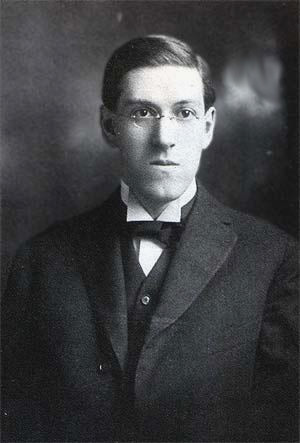
lovecraft

So...what is the deal with Lovecraft?

I recently set about reading a collection of selected letters from Lovecraft's correspondence.  It has had a tremendous effect on me.  I hope to shed some light on that here.


H. P. Lovecraft was a horror writer in the early 20th century, a Rhode Islander by breeding and an 18th-century English country squire by temperament.  He wrote some very terrifying stuff, and worked the gamut of scary from monsters-in-the-dark to humanity's-cosmic-insignificance.  Virtually unknown as a writer at the time of his death in 1937, his popularity has grown steadily since, so that today nearly everyone who considers herself a reader has at least heard of him.  Even if you're not so well-read, odds are that his work has influenced multiple pieces of entertainment that you enjoy.  Although he was most famous for his works that created the Cthulhu mythos, they numbered very few in comparison to the larger part of his writing.  He perceived himself as carrying on the literary tradition of Edgar Allan Poe, and he nursed a lifelong penchant for the weird into his sorrowfully early grave.

I have read many (certainly not most) of his works, and they always struck a chord in me.  Traditionally "scary" books and movies don't do much to frighten me; how can you be surprised when you know surprises are coming?  But Lovecraft has a defter touch, and his writing instills you with horror not with the terror inherent in its subject matter, but with the awful truths he forces you to recognize and grapple with.  "Boo" can be scary.  A bloodless corpse can be scarier.  But Lovecraft plays the instrument of human fear like a master, and brings us face-to-face with existential terrors too awful to contemplate.

But I could gush over his fiction all day.  That's not what this is about.  I hoped to use Lovecraft as a character in a story I was working on, and to that end, I decided to explore his psyche through the greatest insight into his mind he provided us -- thousands of letters to his close friends and family, thoughfully preserved by those lucky individuals.  Lovecraft himself kept none of the letters he received; he treated postal correspondence as though it were as flighty as words spoken into the air.

I got my hands on the Selected Letters, painstakingly gathered and edited by August Derleth and James Turner, and happily began reading them.  Before long, however, I realized that Lovecraft and I shared an especial connection.  At times, it seemed as though his thoughts were reaching over the decades to connect with mine.  Other times, I was simply disgusted by some of his views on the world; how lucky I am to look back with a modern perspective!  But even then, I understood where he was coming from, even if I disagreed.  A very rational man, that Lovecraft.  Disturbingly so.

I've given up on that story, but no matter; I'm still fully committed to finishing his letters.  Enough of his life and thoughts track mine that I have virtually no choice in the matter, if only to gain some clues into my own future .  Which is not to say that I think we're fated to go down the same path -- I just feel that coincidence has put a similar mind into a similar set of circumstances, and I would be foolish not to learn from his example.

Also, I truly feel that Lovecraft's writing expresses to perfection many of my own thoughts on life, truth, meaning, virtue, and happiness.  Rather than go through the onerous process of paraphrasing, I figured I'd just serve up his thoughts to you directly.  So you may feel free to click below for my own choice excerpts:

Scott's Selections from Selected Letters of Lovecraft, 1911-1924

I have only just finished the first volume.  There are four of these left to go.  Once I've perused them, I hope to provide similar sets of excerpts with my favored letters chosen.  Note that I have given a title to each letter, visible under the bookmarks section, referencing the letter's meaning or the part of it that most moved me.  I've also drawn a circle around the numbers and addressees of the letters I actually mean for you to read (as some have been inadvertently included as a factor of the scanning process.)

A final note:  Lovecraft was a horrible racist.  His racialist attitudes, at least as of 1924, place him more closely in line with Hitler than American-style racism.  He's more than a white supremacist; he's an Aryan supremacist, although I don't think that term had come into common use by 1924.  Obviously I disagree universally with all of his views concerning race.  But there is value, too, in seeing how an otherwise brilliant, sympathetic, kindly soul can be so blighted with hatred and contempt by a poor education.  We should all give thanks for the suffering endured by our forebears, that we might live in a slightly more enlightened time.